Why Every Hacker Eventually Falls in Love With Old ThinkPads
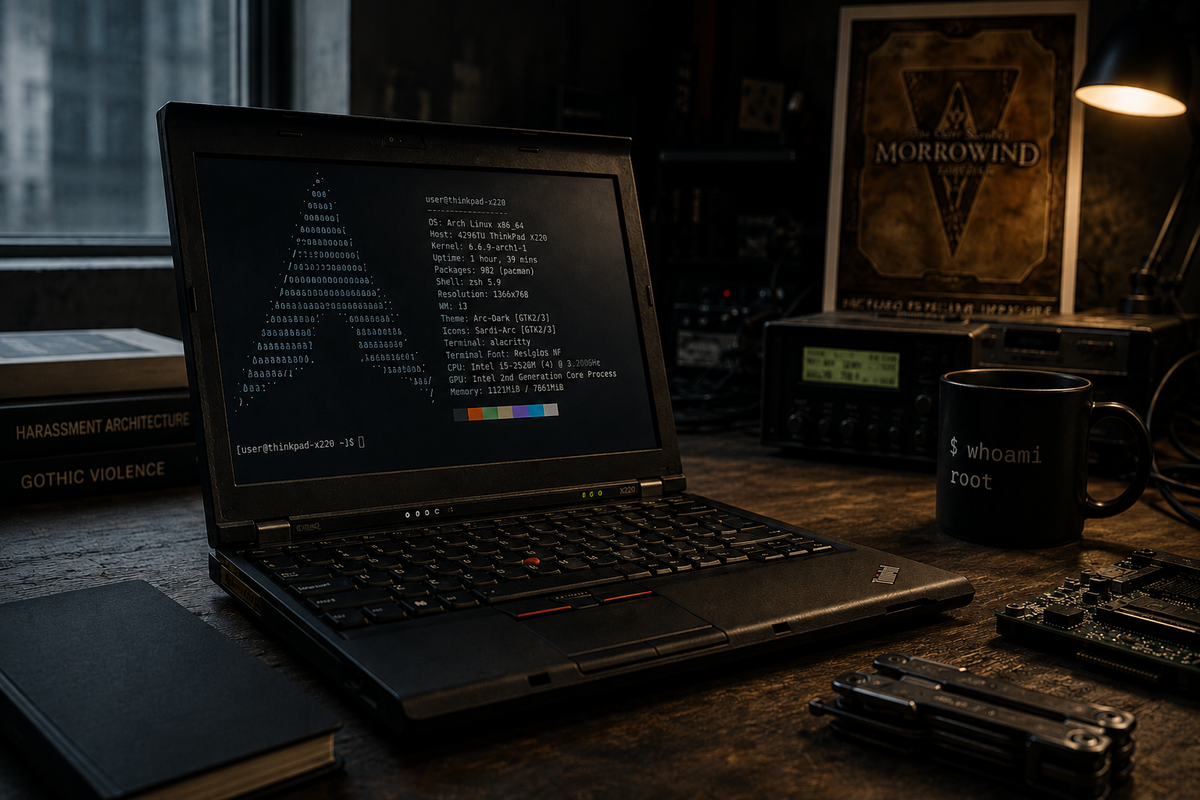
The hinge squeaks when you open it.
Not loudly. Just enough to sound mechanical in a way modern laptops rarely do anymore. The plastic has that strange soft texture that only older electronics seem to develop after years of heat, nicotine, backpacks, coffee spills, basement air, and human skin. The keyboard flexes slightly under pressure. Somewhere inside the machine, a tiny fan spins like an exhausted surveillance drone trying to stay awake.
And despite all of that, the thing boots.
Maybe not quickly. Maybe not gracefully. But it boots every single time.
There is a reason old ThinkPads keep appearing in hacker spaces, Linux meetups, IRC screenshots, darknet documentaries, and grainy YouTube videos filmed under red LEDs at 2am. Once you spend enough time around people who break systems for curiosity or survival, you start noticing the same black rectangle appearing over and over again. Like a recurring symbol in dreams.
Eventually, you understand why.
The Modern Laptop Feels Hostile
A lot of modern hardware feels emotionally distant. Sealed shut. Sanitized. Built to discourage contact.
You pick up a new ultrabook and it feels less like a machine and more like an appliance leased to you temporarily by a corporation that assumes you will behave incorrectly. The screws are proprietary. The keyboard is flat and lifeless. The BIOS looks like a toy menu from a smart refrigerator. RAM is soldered directly to the board because apparently upgrading your own hardware became culturally suspicious at some point.
Even the aesthetics changed. Everything became silver. Rounded. Softened. Minimalist in the same way luxury condos are minimalist. Expensive emptiness.
Old ThinkPads feel different.
They feel built by engineers who assumed the user might eventually need to survive something.
Not aesthetically. Structurally.
You can open many of them with a screwdriver from a gas station multitool. Parts are replaceable. Documentation exists. Linux usually works without ritual sacrifice. Some models still have removable batteries, physical latches, proper keyboards with travel deep enough to feel intentional. They were made during a strange era where computers still resembled equipment instead of lifestyle accessories.
That distinction matters more than people realize.
Especially to hackers.
The Keyboard Changes Your Brain Slightly
This sounds irrational until you spend a few weeks typing on one.
Then you notice it.
The older ThinkPad keyboards, especially the classic seven row layouts, create a strange psychological effect where writing commands starts feeling tactile again. Not metaphorically tactile. Physically tactile. You can feel force transfer through the chassis. The keys have weight and resistance. Certain shortcuts become muscle memory faster because your fingers receive actual feedback instead of tapping on polished chiclet glass tiles pretending to be keys.
It changes terminal use.
You stop feeling like you're interacting through a layer of abstraction and start feeling mechanically connected to the system itself. Tiny thing. Hard to quantify. But it accumulates over time.
A lot of hackers become obsessed with efficiency, but eventually many drift toward something else entirely: intimacy with tools.
That is what the ThinkPad provides.
An intimacy modern hardware often destroys.
They Look Like Devices That Belong Somewhere Underground
There is also the visual component. People pretend aesthetics are superficial, then spend ten thousand dollars decorating rooms to influence mood.
Old ThinkPads look correct.
Not flashy. Not “retro” in the forced neon nostalgia way companies try to market now. They look industrial. Severe. Utilitarian. Like something recovered from an archive bunker beneath an abandoned telecommunications facility.
A scratched X220 sitting on a diner table beside a black coffee and tangled USB adapters looks more believable than most “cyberpunk” props in movies.
Part of this comes from restraint. The matte black shell. The tiny red TrackPoint glowing in the center like an artificial pupil. Minimal branding. Almost military.
There is an accidental honesty to the design.
These machines were made before every object became desperate to signal status online.
Hackers notice that immediately.
Linux and ThinkPads Grew Together Like Mold and Concrete
Spend enough time in Linux circles and you start hearing the same sentences repeatedly.
“WiFi worked immediately.”
“Suspension actually works.”
“No weird driver issues.”
“It just runs stable.”
This relationship between ThinkPads and Linux became semi-mythological because it was earned slowly over decades. IBM and later Lenovo machines consistently had strong compatibility with Linux distributions, especially compared to consumer laptops that treated Linux support like an unfortunate accident.
And once someone installs Linux successfully on an old ThinkPad for the first time, something strange tends to happen.
The machine feels alive again.
A laptop abandoned by mainstream software ecosystems suddenly becomes lightweight, efficient, adaptable. Old hardware that struggled under bloated operating systems starts moving with eerie responsiveness under Arch, Debian, Void, Gentoo, or whatever strange handcrafted setup the user builds at 4am while listening to ambient drone music and reorganizing dotfiles.
You start seeing the machine less as obsolete hardware and more as reclaimed territory.
That feeling sticks.
The TrackPoint Becomes a Religion
People laugh about the red nub until they use it seriously for two weeks.
Then they start defending it with cult energy.
The TrackPoint looks ridiculous to outsiders because it violates modern interface expectations. But once your hands adapt, it becomes absurdly efficient. You move the cursor without lifting your fingers from the home row. Tiny adjustments become immediate. Navigating terminals, code editors, packet analysis tools, and browser tabs starts feeling strangely fluid.
It also changes posture.
A lot of heavy keyboard users quietly develop a rhythm where the TrackPoint reduces unnecessary hand movement enough to feel physically noticeable during long sessions. Less drifting toward touchpads. Less interruption.
There is a reason many programmers who abandon ThinkPads eventually miss the TrackPoint specifically.
It rewires workflow in subtle ways.
And subtle things are where obsession begins.
Old ThinkPads Reward Curiosity Instead of Punishing It
Modern devices increasingly discourage exploration.
Open the wrong thing, void the warranty.
Install the wrong OS, lose compatibility.
Replace the wrong component, trigger firmware complaints.
Old ThinkPads feel more permissive.
You can swap keyboards. Replace displays. Upgrade RAM. Install bizarre operating systems. Flash custom firmware. Turn one into a cyberdeck. Build a portable wardriving rig. Convert another into a dedicated writing machine disconnected from modern noise entirely.
People have mounted antennas onto them. Embedded SDR hardware inside them. Used them for car diagnostics, radio experiments, darknet servers, synth control systems, retro gaming, packet sniffing, field notes, war driving, and weird art installations.
The machines tolerate experimentation.
That tolerance creates attachment.
Hackers rarely fall in love with perfect systems. They fall in love with systems that invite participation.
The Scarcity Makes Them Feel Personal
A brand new MacBook feels interchangeable. Walk into any coffee shop and there are twelve identical silver slabs glowing like synchronized consumer mollusks.
Old ThinkPads develop individuality.
One has cigarette burns near the arrow keys. Another has faded stickers from defunct Linux conferences. Another arrived from a university surplus warehouse with mysterious BIOS passwords and an inventory tag from 2011 still attached.
Somebody used these machines before you. Hard.
And unlike modern devices, the wear improves the atmosphere instead of degrading it.
Scratches become history.
A dented ThinkPad with a battered shell and custom Linux setup feels less like a product and more like a companion object. Almost ritualistic. Like a field notebook or old camera body.
You begin configuring it slowly. Tweaking terminal colors. Changing bootloaders. Building tiny workflows nobody else understands. Naming scripts strange things. Organizing encrypted drives like hidden rooms inside a collapsing monastery.
After enough time, the machine starts reflecting the operator psychologically.
That is difficult to manufacture artificially.
They Resist Planned Obsolescence Better Than Expected
Some older ThinkPads simply refuse to die.
You still see X220s from 2011 running daily workloads. T420s upgraded with SSDs and extra RAM still handling development work. Ancient T60 machines turned into distraction free writing devices. X61 tablets repurposed into field terminals.
Modern tech culture constantly pushes replacement cycles. Faster. Thinner. Newer. AI-enabled toothbrush refrigerator ecosystems connected to six subscription services and an app that harvests behavioral telemetry while pretending to optimize hydration.
Meanwhile some dusty ThinkPad from the Obama administration is quietly running Debian in perfect silence.
There is something spiritually satisfying about that.
Especially for people already skeptical of corporate ecosystems.
Hackers Tend to Romanticize Functional Decay
This is probably the least discussed part.
Hackers, especially the underground-adjacent kind, often develop emotional attachment to imperfect infrastructure. Not because imperfection is objectively better, but because decay exposes system anatomy.
An old ThinkPad reveals itself constantly.
The battery weakens visibly.
The fan noise changes under load.
The chassis creaks.
The display yellows slightly.
Thermals become understandable instead of hidden behind optimization layers.
You become aware of the machine as a physical object instead of an invisible service portal.
That awareness creates respect.
And respect becomes affection faster than most people expect.
There Is a Certain Kind of Freedom in Using “Outdated” Hardware
Using old ThinkPads creates a subtle psychological separation from mainstream upgrade culture.
You stop caring about benchmarks as much.
You stop chasing aesthetic trends every six months. You stop optimizing for social signaling. The machine becomes a tool chosen intentionally instead of a status object inherited from algorithmic recommendation sludge.
Ironically, this often makes people more productive.
Constraints simplify behavior.
An old ThinkPad running a lean Linux environment with carefully selected software feels calm compared to the modern productivity carnival of AI assistants, telemetry dashboards, collaborative cloud overlays, subscription popups, and attention extraction systems disguised as workflows.
The machine becomes quiet.
Not silent technically. The fan probably sounds like a dying moth trapped in ductwork. But cognitively quiet.
That matters.
Especially now.
The Hacker and the ThinkPad Eventually Start Resembling Each Other
This sounds dramatic, but watch long term ThinkPad users carefully.
They tend to value repairability.
Self sufficiency.
Documentation.
Adaptability.
Durability over appearance.
Function over prestige.
Control over convenience.
The laptop becomes symbolic after a while.
Not in a cringe “elite hacker aesthetic” sense. More like an externalization of priorities. A machine aligned with a worldview where systems should remain understandable, modifiable, and personally owned.
A lot of people enter hacking through excitement. Exploits, gadgets, darknet mythology, terminal screenshots.
But if they stay long enough, many drift toward something quieter.
Sovereignty.
That is where the ThinkPad waits for them.
Usually scratched to hell. Running Linux. Covered in old stickers. Battery held in place with electrical tape. Sitting on a desk beside tangled adapters and a half finished cup of coffee gone cold three hours ago.
Still booting.
Still useful.
Still here.